Cursor Wrapped 2025
Literally, as I was fact-checking my ass(ertion) that nobody had done a "Wrapped" summary like Spotify for token usage, Cursor drops their own "Year in Code" summary. Perfect timing.
Even if I had all the data (I didn't), and even if ChatGPT or Claude analyzed it (they did), there's one thing that I could've never cooked up: bragging rights.
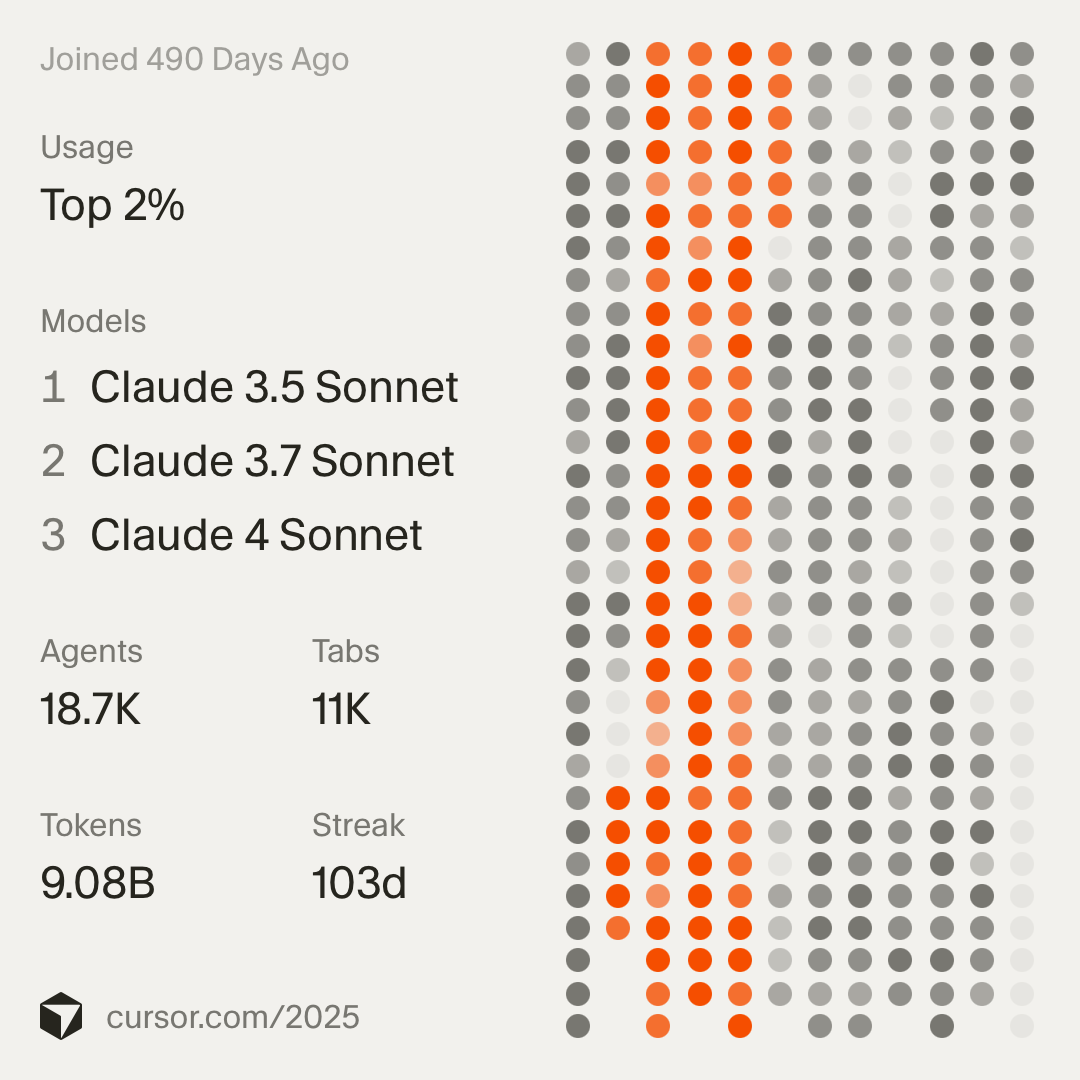
According to Cursor, I generated 9.08 billion tokens in 2025. I made 18.7K agent requests, and 11K tab-edits. My longest streak lasted 103 consecutive days. Top 2% of all Cursor users.
And that doesn't even include tokens from Codex, Antigravity, CoPilot, or the OpenAI API.
So, what did I actually get for those 9 billion tokens?
Stats
- 3,499 commits
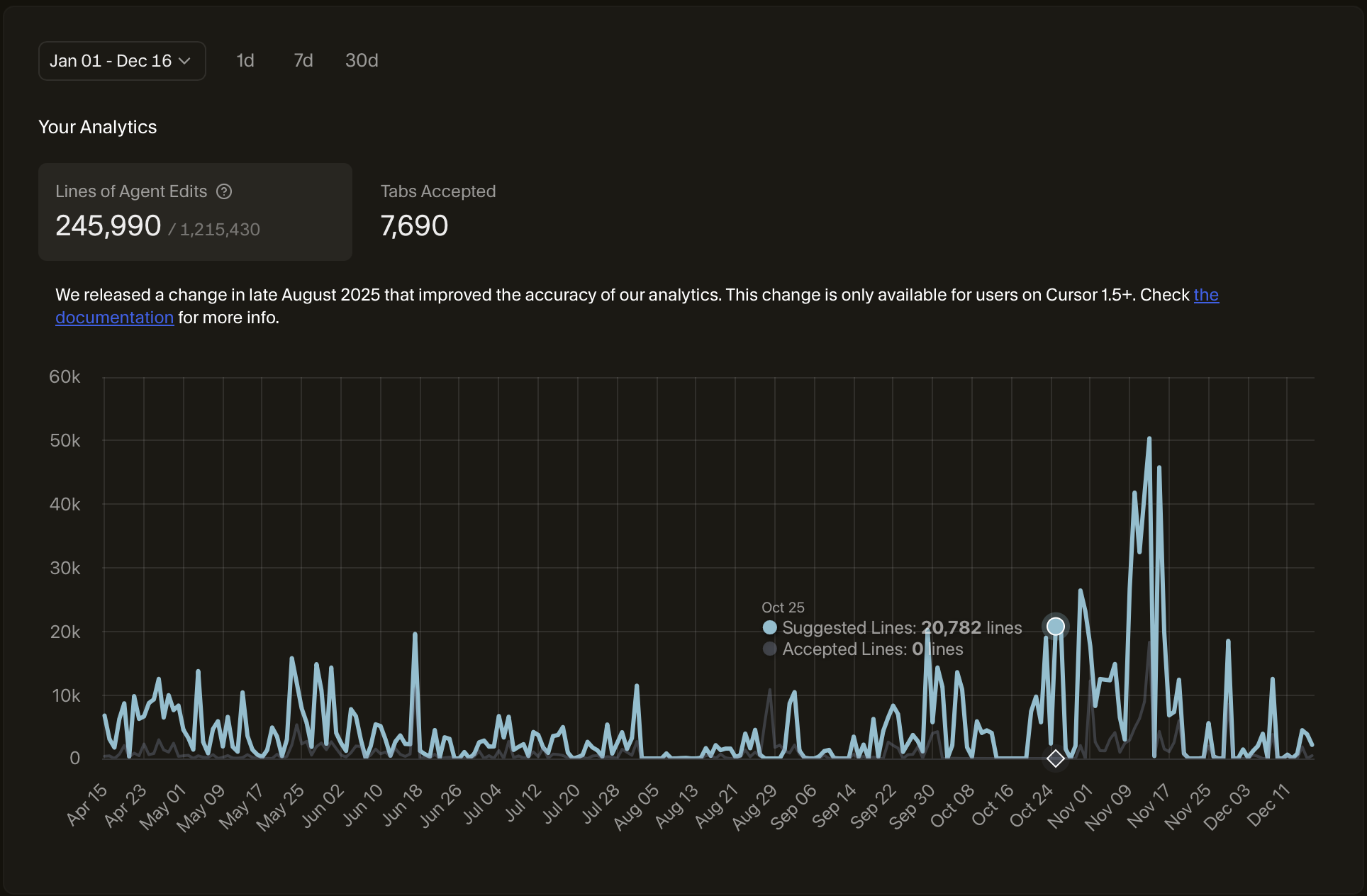
- 1,215,430 lines of code generated
- 245,990 lines of code accepted
- 20% acceptance rate
Closing Thoughts
Vanity metrics aside, I want to know what really matters from an AI-codegen perspective.
Naturally, the model makers & wrapper companies will highlight token quantity, but I think there's more to it than that. What does quality actually look like here? Two thoughts:
- Acceptance Rate. A higher acceptance rate means the AI is able to generate code that is more likely to be correct and useful. Conversely, it might indicate a more discerning (or untrusting) developer.
- Agent vs. Tab Ratio. Agents is fully-hands off, while tabs require more manual intervention. The extent to which a dev gets into the weeds of the code, will likely be reflected by this ratio.
Although many devs, myself included, were vibe-coding for months before Karpathy coined the term, I don't think any of us realized how quickly and completely this new paradigm would transform the software development lifecycle.
To say that 2025 was the year of agents and vibe-coding is an understatement.
We ain't seen nothing yet.
Alec is a full-stack developer and AI tinkerer with deep hands-on experience building generative AI apps, Model Context Protocol (MCP) integrations, and enterprise SaaS architectures. In 2025, he shipped 3,500 commits, representing 245k lines of code, and over 10 billion tokens generated, pioneering agentic commerce patterns and building production-grade AI tooling for creative and enterprise workflows.
His work spans the full stack—from schema design and multi-tenant security to polished React interfaces—with a particular focus on bridging AI capabilities with real-world business applications.